
 Facebook
  Masuk dengan Email




Penggunaan furosemide pada gagal ginjal tahap lanjut kerap menjadi dilema, terutama terkait efikasi, keamanan, dan manfaat jangka panjangnya. Di satu sisi, furosemide digunakan untuk mengendalikan kelebihan cairan, mengurangi edema, dan memperbaiki gejala kongestif. Di sisi lain, penggunaannya pada pasien dengan fungsi ginjal yang sangat terbatas dapat menimbulkan risiko seperti ketidakseimbangan elektrolit, hipotensi, maupun nefrotoksisitas.
Peran Furosemide dalam Penanganan Gagal Ginjal Tahap Lanjut
Seiring penurunan fungsi ginjal pada pasien penyakit ginjal kronis (CKD), sejumlah zat terlarut yang normalnya dikeluarkan dari ginjal yang sehat akan tertahan di tubuh. Akumulasi zat terlarut tersebut dapat mengganggu satu atau lebih fungsi biologis normal. Hal ini disebut dengan uremic toxin.[1,2]
Uremic toxin (UT) dikategorikan menjadi molekul kecil larut-air, komponen terikat protein (PBUT), dan middle molecule. UT merupakan faktor risiko terkait CKD yang berkontribusi terhadap progresi gagal ginjal, morbiditas dan mortalitas kardiovaskuler, serta disfungsi tulang. Selain itu, UT merupakan penyebab utama dari gejala klinis gagal ginjal.[3,4]
Eliminasi PBUT didominasi oleh saluran influks spesifik pada tubulus proksimal ginjal yang dikenal dengan organic anion transporter 1 dan 3 (OAT 1, OAT 3). Pada penanganan CKD, pasien umumnya mendapat polifarmasi yang pada gilirannya dapat mengganggu sistem OAT tubulus.[5-7]
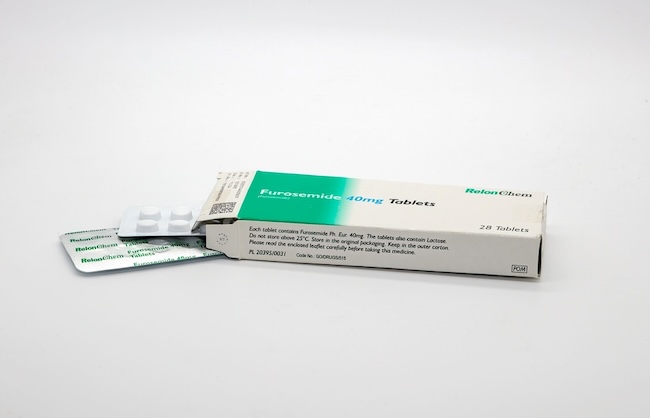
Sejumlah studi telah menunjukkan bahwa beberapa obat dapat menginhibisi OAT1 atau OAT3 yang berkontribusi pada akumulasi PBUT. Salah satu obat yang lazim diresepkan pada pasien CKD ialah furosemide. Studi in vivo dan in vitro telah menunjukkan bahwa furosemide memiliki efek inhibisi terhadap OAT1 dan OAT3 pada dosis terapeutik.[6-12]
Manfaat Penggunaan Furosemide pada Gagal Ginjal Tahap Lanjut
Rasionalisasi penggunaan diuretik pada pasien gagal ginjal dilatarbelakangi oleh kondisi fluid overload. Manfaat penggunaan furosemide pada gagal ginjal tahap lanjut mencakup membantu mempertahankan residual kidney function, meningkatkan volume urin, menurunkan kejadian hipokalemia, serta menurunkan risiko mortalitas kardiovaskuler.[13-18]
Mempertahankan Residual Kidney Function (RKF)
Manfaat furosemide pada gagal ginjal tahap lanjut adalah membantu mempertahankan RKF. Studi acak skala kecil terhadap 19 pasien menunjukkan bahwa diuretik dosis rendah mampu menjaga RKF, sekaligus melindungi fungsi jantung.
Hal ini dicapai melalui pelestarian klirens ginjal terhadap urea total, pengurangan pertambahan berat badan interdialisis, penurunan kejadian hipotensi, dan pencegahan myocardial stunning. Studi lain juga melaporkan bahwa pasien pengguna diuretik memiliki kemungkinan dua kali lipat untuk mempertahankan residual diuresis setahun setelah dialisis dimulai.[13,14,17]
Meningkatkan Volume Urin dan Natriuresis
Efek lain yang konsisten ditemukan adalah peningkatan volume urin dan natriuresis. Sebuah studi pada pasien hemodialisis melaporkan bahwa pemberian furosemide dosis tinggi (500–2000 mg/hari) selama satu tahun meningkatkan volume urin, natriuresis, dan kaliuresis, meskipun efek ini cenderung menurun seiring waktu.[15]
Pada pasien dialisis peritoneal, sebuah uji acak terkontrol pada 61 pasien juga menunjukkan hasil serupa. Dalam populasi pasien ini, penggunaan furosemide dilaporkan berkaitan dengan peningkatan volume urin dan ekskresi natrium dibandingkan dengan kelompok kontrol.[16]
Menurunkan Risiko Hiperkalemia dan Hipotensi
Studi berskala besar memberikan bukti tambahan mengenai peran furosemide dalam menurunkan komplikasi metabolik dan hemodinamik. Data DOPPS (16.420 pasien) menunjukkan bahwa penggunaan diuretik berhubungan dengan penurunan kejadian hiperkalemia.[17]
Penelitian lain pada 11.297 pasien hemodialisis di Amerika Serikat juga melaporkan bahwa melanjutkan terapi diuretik dapat mengurangi kejadian hipotensi intradialisis serta menurunkan frekuensi rawat inap.[18]
Mortalitas Kardiovaskuler
Beberapa bukti juga menyoroti kaitan penggunaan furosemide dengan luaran klinis jangka panjang. Analisis DOPPS menemukan bahwa penggunaan diuretik berhubungan dengan penurunan risiko mortalitas kardiovaskuler sebesar 14% (p<0,03). Meski begitu, studi observasional skala besar di Amerika Serikat melaporkan pengurangan rawat inap namun tidak menemukan penurunan signifikan pada mortalitas satu tahun.[17,18]
Studi Ingwiller et al. (2024) mengevaluasi dampak mortalitas dan morbiditas dari pemberian loop diuretic, termasuk furosemide, pada pasien CKD yang memulai dialisis. Studi tersebut menggunakan data registrasi nasional Perancis (REIN) yang dihubungkan dengan data national health data system (SNDS). Studi ini melaporkan bahwa penggunaan diuretik berkaitan dengan penurunan tingkat mortalitas secara statistik dalam 2 tahun pengamatan.
Meski demikian, studi ini tidak melakukan subanalisis mengenai dosis furosemide yang digunakan. Lebih dari 80% pasien yang terlibat mendapat sedikitnya dosis 500 mg furosemide. Selain itu, keterbatasan lainnya adalah tidak ada data analisis mengenai dampak furosemide terhadap residual diuresis ataupun pertambahan berat badan interdialisis.[13]
Risiko Penggunaan Furosemide pada Gagal Ginjal Tahap Lanjut
Meski sejumlah studi melaporkan manfaat furosemide, risiko penggunaannya tetap perlu diwaspadai. Sebuah studi melaporkan bahwa durasi paparan furosemide yang berkepanjangan berhubungan dengan peningkatan kematian semua-sebab dan peningkatan angka morbiditas, khususnya lama rawat inap, dibandingkan dengan kelompok yang mendapat paparan lebih singkat.[13]
Akumulasi Uremic Toxin (PBUT)
Bukti dari percobaan CKD-REIN menyoroti potensi risiko furosemide terhadap peningkatan PBUT pada pasien penyakit ginjal kronis non-dialisis. Studi prospektif kohort cross-sectional ini melaporkan bahwa pasien yang menggunakan furosemide memiliki konsentrasi serum PBUT lebih tinggi dibandingkan mereka yang tidak menggunakannya. Efek ini tampak lebih signifikan pada paparan dosis >120 mg/hari dan bersifat independen dari laju filtrasi glomerulus baseline.[19]
Efek Samping Organ
Penggunaan furosemide juga dikaitkan dengan berbagai efek samping organ yang perlu diwaspadai. Ototoksisitas, hepatotoksisitas, serta gangguan kulit seperti sindrom DRESS dan pemfigoid bullosa telah dilaporkan dalam literatur.
Di ginjal, furosemide dapat memicu calcium-losing nephropathy yang berkontribusi pada hiperparatiroidisme sekunder. Selain itu, kondisi hiperkalsiuria, kehilangan magnesium melalui ginjal, dan kalsifikasi ginjal yang menyerupai sindrom Bartter juga dapat terjadi.[20]
Resistensi Renal terhadap Furosemide
Risiko lain yang cukup penting adalah berkembangnya resistensi renal terhadap furosemide. Kondisi ini biasanya timbul pada penggunaan jangka panjang, di mana efektivitas obat menurun sehingga pasien membutuhkan tambahan obat diuretik lain untuk mencapai efek yang sama. Resistensi ini dapat meningkatkan beban pengobatan pasien.[20]
Kesimpulan
Penggunaan furosemide pada gagal ginjal tahap lanjut memberikan manfaat dalam mengatasi kelebihan cairan, mempertahankan residual kidney function (RKF), meningkatkan volume urin, serta menurunkan risiko komplikasi metabolik dan kardiovaskuler. Sejumlah studi berskala kecil hingga besar mendukung bahwa furosemide berperan dalam mengurangi edema, mencegah hiperkalemia maupun hipotensi, serta berpotensi menurunkan angka mortalitas kardiovaskuler.
Di sisi lain, paparan jangka panjang furosemide telah dikaitkan dengan peningkatan mortalitas semua sebab, lama rawat inap, akumulasi protein-bound uremic toxin, serta berbagai efek samping organ seperti ototoksisitas, gangguan kulit, dan nefropati. Resistensi renal terhadap furosemide pada penggunaan kronis juga perlu diwaspadai. Oleh sebab itu, keputusan penggunaan furosemide pada pasien gagal ginjal tahap lanjut harus didasarkan pada evaluasi individual, dengan menimbang potensi manfaat dan risiko