
 Facebook
  Masuk dengan Email




Penanganan luka kronis memerlukan pendekatan strategis yang mencakup debridemen, antibiotik dan antiseptik sesuai indikasi, serta balutan (dressing) yang tepat. Pada luka kronis, seringkali memiliki kolonisasi berbagai mikroorganisme yang membentuk biofilm, sehingga antibiotik sistemik atau topikal mungkin tidak efektif. Antiseptik spektrum luas seperti PVP-I yang dikombinasikan dengan debridemen meningkatkan penyembuhan luka kronis dan lebih efektif melawan biofilm.[1-3]
Luka kronis adalah luka yang tidak sembuh setelah 4 minggu sejak awal munculnya luka. Luka kronik umumnya akibat tata laksana yang kurang tepat, tetapi bisa juga akibat penyakit primer yang memperburuk kondisi luka. Sementara itu, antiseptik dikenal sebagai agen topikal dengan aktivitas spektrum luas yang dapat menghambat pertumbuhan mikroorganisme.[1-4]
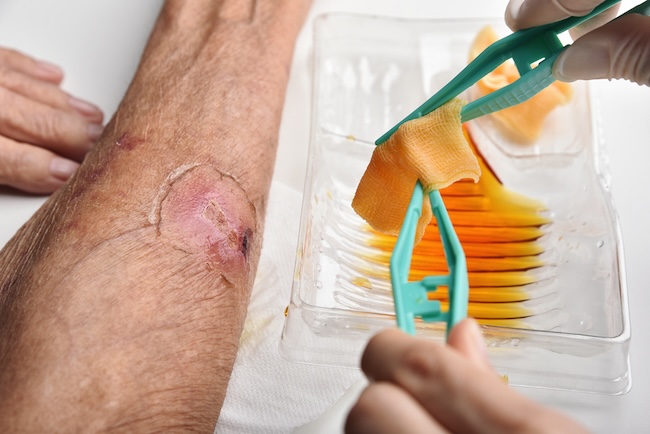
Fase Penyembuhan Luka Normal
Penyembuhan luka adalah proses yang sangat teratur dan dinamis, yang melibatkan partisipasi berbagai sel imun dan struktural. Penyembuhan luka meliputi fase hemostasis/perdarahan, fase inflamasi, fase proliferasi, dan fase remodeling. Kegagalan proses penyembuhan sesuai fasenya secara teratur dan tepat waktu dapat menyebabkan luka kronis.[5,6]
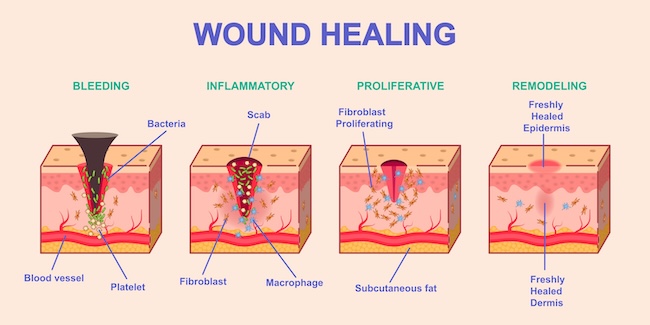
Gambar 1. Fase Penyembuhan Luka
Penyembuhan luka dimulai dengan fase hemostasis, di mana trombosit mulai teragregasi dan terperangkap dalam serat fibrin, membentuk bekuan darah (clot). Setelah itu, fase inflamasi dimulai dengan perekrutan neutrofil yang memproduksi reactive oxygen species (ROS), untuk menghindari infeksi luka dan mendorong proliferasi fibroblas serta angiogenesis. Selanjutnya, monosit direkrut dan berdiferensiasi menjadi makrofag M1 yang menghasilkan sitokin proinflamasi dan membersihkan debris neutrofilik.[6]
Selama fase proliferasi, makrofag berdiferensiasi menjadi makrofag M2. Makrofag M2 ini akan menghasilkan endothelial growth factor (EGF) yang merangsang keratinosit untuk memulai re-epitelisasi, vascular endothelial growth factor (VEGF) yang mendorong proses angiogenesis, dan fibroblast growth factor (FGF) yang merangsang multiplikasi fibroblas. Kolagen akan mulai terbentuk dan menggantikan gumpalan fibrin dengan jaringan granulasi.[6]
Terakhir, extracellular matrix (ECM) yang diproduksi oleh fibroblas akan menggantikan jaringan granulasi, sehingga penghalang kulit dipulihkan. Selain itu, aktivitas miofibroblas akan membantu luka berkontraksi.[6]
Penyembuhan Luka Kronis
Luka kronis ditandai dengan stagnasi fase inflamasi, sehingga terdapat neutrofil dan makrofag yang berlebih di dalam luka, dengan produksi ROS yang berlebihan dan degradasi ECM. Situasi ini mendorong kolonisasi bakteri dan pembentukan biofilm, yang selanjutnya mengganggu penyembuhan dan respons terhadap pengobatan. Luka kronis ditandai dengan defek angiogenesis yang menyebabkan nekrosis, gangguan reepitelisasi, dan penuaan fibroblas, di mana produksi ECM menjadi tidak mencukupi.[6]
Pembentukan Biofilm pada Luka Kronis
Salah satu faktor yang meningkatkan kemungkinan luka terinfeksi dan menyebabkan luka kronis adalah adanya biofilm. Biofilm adalah struktur multiseluler yang terdiri dari beberapa spesies bakteri, yang menempel dan terbungkus dalam extracellular polymeric substances (EPS). EPS merupakan lapisan polisakarida, protein, glikolipid, dan DNA ekstraseluler yang mampu melindungi bakteri.[5,7,8]
Pembentukan biofilm melalui adhesi bakteri planktonik, yang diikuti oleh pembentukan mikrokoloni dan maturasi biofilm tempat mikroorganisme berperilaku sebagai suatu komunitas. Adanya biofilm, menyebabkan mikroorganisme mampu bertahan hidup dan kebal terhadap sistem imun inang.[6]
Meta analisis, pada tahun 2017 dan melibatkan 185 luka kronis, melaporkan bahwa prevalensi biofilm pada luka kronis adalah 78,2%. Hasil ini mendukung asumsi klinis bahwa biofilm terdapat pada luka kronis yang tidak kunjung sembuh.[9]
Pembentukan biofilm ditemukan sebagai penyebab utama banyak infeksi kronis, seperti ulkus diabetikum kaki dan necrotizing fasciitis, yang menyebabkan munculnya kembali strain yang resistan terhadap banyak obat dan mengakibatkan kegagalan pengobatan.[5,6,10]
Faktor Risiko Luka Kronis
Beberapa faktor yang menyebabkan keterlambatan atau kegagalan penyembuhan luka kronis adalah usia dan status gizi pasien, serta riwayat komorbid seperti diabetes melitus, imunodefisiensi, atau kanker. Selain itu, beberapa terapi juga dapat menghambat penyembuhan luka, misalnya kemoterapi, radioterapi, serta penggunaan jangka panjang kortikosteroid atau obat antiinflamasi nonsteroid (OAINS).[1,6,11]
Manajemen Luka Kronis dan Peran Antiseptik Topikal
Dalam tata laksana luka kronis, khususnya luka dengan biofilm, dibutuhkan debridemen yang dikombinasi dengan antibiotik sistemik atau antiseptik topikal. Debridemen bertujuan untuk menghilangkan jaringan yang rusak, debris, dan lapisan luar biofilm, sehingga populasi mikroba akan lebih mudah terekspos oleh pengobatan.[11,12]
Antibiotik untuk luka kronis biasanya diberikan secara sistemik dan topikal. Namun, penggunaan topikal secara berlebihan dapat menyebabkan resistansi bakteri pada luka kronis, sehingga agen lain diperlukan untuk membantu tata laksana agar menjadi efektif.[4]
Antiseptik sebagai agen topikal memiliki aktivitas spektrum luas yang dapat menghambat pertumbuhan mikroorganisme. Berbeda dengan antibiotik yang hanya membunuh (efek biosidal) atau menghambat pertumbuhan bakteri (efek statis), antiseptik bersifat tidak spesifik/multitarget dan memiliki spektrum aktivitas antimikroba yang luas.[4,13]
Antiseptik memiliki efek biosidal pada bakteri, jamur, parasit, dan virus. Oleh karena itu, penggunaan antiseptik dapat dipertimbangkan dalam tata laksana luka kronis.[4,13]
Keunggulan Antiseptik Topikal Povidone Iodine (PVP-I)
Terdapat beberapa golongan antiseptik, yang memiliki mekanisme kerja, spektrum antimikroba, dan profil resistansi yang berbeda. Povidone iodine (PVP-I) adalah antiseptik turunan yodium yang memiliki spektrum aktivitas antimikroba lebih luas daripada antiseptik polyhexamethylene biguanide (PHMB) maupun chlorhexidine (CHG).[14]
Keunggulan antiseptik PVP-I adalah:
- Spektrum aktivitas yang luas, baik terhadap bakteri Gram-positif dan Gram-negatif, jamur, protozoa, virus, spora bakteri, maupun amuba
- Tidak ada laporan resistansi bakteri
- Tidak ada laporan resistansi silang terhadap antibiotik atau antiseptik lainnya
- Mekanisme antimikrobanya cocok untuk mengelola biofilm[11]
Mekanisme kerja adalah yodium mengoksidasi asam lemak, asam amino, dan asam nukleat, yang menyebabkan destabilisasi membran sel, deaktivasi enzim sitosol, dan gangguan jalur metabolisme internal.[11]
Penelitian terkait Penggunaan Povidone Iodine (PVP-I)
PVP-I tersedia dalam bentuk cairan atau salep, yang telah dikenal sebagai antiseptik topikal pilihan untuk luka akut maupun kronis. Beberapa penelitian telah menilai efektivitas PVP-I terhadap biofilm.
Secara in vitro, konsentrasi sub-inhibitor PVP-I (0,17%, 0,35%, dan 0,7%) terbukti dapat menghambat perkembangan biofilm oleh Staphylococcus epidermidis dan Staphylococcus aureus, dua spesies bakteri paling umum yang ditemukan dalam luka kronis. Sementara, penelitian in vitro juga menunjukkan bahwa PVP-I dosis rendah (0,25%) dapat menghilangkan biofilm yang terbentuk dari Staphylococcus aureus, Klebsiella pneumoniae, Pseudomonas aeruginosa, dan Candida albicans yang resistan terhadap berbagai obat.[11]
Studi in vitro lain menemukan bahwa PVP-I sepenuhnya membasmi biofilm S. aureus dan P. aeruginosa hanya setelah 15 menit aplikasi.[11] Dalam model biofilm kompleks, larutan PVP-I 10% menghancurkan biofilm awal (90 menit) maupun biofilm matur (48 jam) yang dibentuk oleh Candida auris, jamur yang resistan terhadap berbagai obat yang sedang berkembang.[15]
Penggunaan Klinis Povidone Iodine (PVP-I) dalam Manajemen Luka Kornis
Berikut prosedur yang diusulkan untuk perawatan luka kronis yang tidak kunjung sembuh akibat kolonisasi kritis dan/atau biofilm:
- Cuci dan scrub luka dengan sabun atau larutan PVP-I untuk mengangkat biofilm dan kotoran/
- Debridemen luka jika perlu, untuk merusak biofilm.
- Desinfeksi luka menggunakan kasa yang telah diberi larutan PVP-I selama minimal 1 menit, untuk membunuh seluruh mikroorganisme yang tersisa.
- Lakukan kontrol luka secara rutin, karena biofilm dapat muncul kembali setelah 24 jam debridemen.
- Pada luka dengan eksudat ringan-sedang, berikan salep PVP-I yang ditutup dengan balutan sekunder. Balutan sekunder digunakan untuk menjaga balutan primer tetap terpasang dengan aman.
- Untuk luka dengan eksudat berat, tutup dengan salep PVP-I yang diaplikasikan di bawah balutan penyerap/absorbent.
- Ganti balutan setiap hari atau lebih sering jika ada perubahan warna balutan.
- Evaluasi proses penyembuhan luka, untuk menilai ulang kondisi luka setiap minggu, dan ulangi prosedur ini jika diperlukan.[11]
PVP-I tersedia dalam bentuk cair/larutan dan salep. Salep dapat meningkatkan efikasi dan penyerapan PVP-I, serta mencegah perlengketan. Namun, salep tidak terlalu direkomendasikan untuk luka dengan sekret atau eksudat yang banyak.[17]
Antiseptik pada Ulkus Diabetikum Kaki dengan Kolonisasi Kritis
Ulkus diabetikum kaki atau diabetic foot ulcer (DFU) merupakan salah satu komplikasi diabetes melitus yang paling signifikan. Ulkus diabetikum kaki didefinisikan sebagai ulserasi akibat neuropati dan/atau penyakit arteri perifer pada ekstremitas bawah pasien diabetes melitus.[1]
Penyembuhan ulkus diabetikum kaki sangat diperburuk oleh pembentukan biofilm. Selain itu, bakteri yang menyebabkan ulkus ini biasanya resistan terhadap banyak obat sehingga penyembuhan luka semakin lambat.[16]
Penelitian Efektifitas Povidone Iodine (PVP-I) Topikal pada Ulkus Diabetikum Kaki
Pada kasus ulkus diabetikum kaki, penggunaan PVP-I dapat dipertimbangkan. Penelitian retrospektif, terhadap 30 pasien dengan total 42 ulkus diabetikum kaki, mendapatkan 29% luka mencapai penutupan penuh dan 45% mencapai penutupan sebagian dalam waktu 6 bulan setelah aplikasi PVP-I topikal secara teratur.[17]
Selain itu, penelitian praklinis menunjukkan bahwa PVP-I meningkatkan penyembuhan luka melalui peningkatan ekspresi transforming growth factor beta (TGF-β), neovaskularisasi, dan reepitelisasi. PVP-I juga memiliki efek hemostatik dan antiinflamasi, serta mengurangi produksi spesies oksigen reaktif oleh neutrofil. Dibandingkan dengan kontrol, PVP-I secara signifikan meningkatkan laju penyembuhan ulkus kronis pada kaki.[18]
Keamanan Penggunaan Antiseptik Topikal PVP-I pada Rawat Jalan
Umumnya, PVP-I topikal dapat ditoleransi dengan baik. Namun, penggunaan PVP-I topikal dikontraindikasikan pada neonatus, bayi prematur, pasien dengan penyakit tiroid yang sudah ada sebelumnya atau menerima terapi radioiodine, dan mereka yang alergi terhadap PVP-I.[17,21]
Iodine dapat diserap melalui kulit, tetapi lebih banyak diserap melalui mukosa. Iodine dengan cepat diubah menjadi iodida, yang kemudian disintesis menjadi tiroksin.[17,21]
Beberapa penelitian in vitro menunjukkan bahwa PVP-I dapat bersifat sitotoksik, tetapi penelitian in vitro cytotoxicity menunjukkan viabilitas sel manusia dengan PVP-I pada konsentrasi bakterisida minimum. Faktanya, penelitian tersebut menemukan bahwa PVP-I memiliki sitotoksisitas yang rendah dibandingkan dengan antiseptik lain yang diuji (seperti PHMB, klorheksidin, dan hidrogen peroksida).[18]
Kesimpulan
Luka kronis adalah luka yang tidak sembuh lebih dari 4 minggu, sehingga meningkatkan rasa sakit dan menurunkan kualitas hidup pasien. Mayoritas luka kronis mempunyai biofilm, suatu koloni mikroba multipel dengan matriks ekstraseluler, sehingga mengurangi efektivitas pengobatan antimikroba saja.
Penggunaan antiseptik PVP-I topikal dengan debridemen direkomendasikan dalam manajemen luka kronis, sebagai agen spektrum luas yang dapat menghambat perkembangan mikroorganisme dan dapat menembus/merusak biofilm sehingga penyembuhan luka lebih baik. Termasuk dalam manajemen ulkus diabetikum kaki, PVP-I sudah terbukti efektif mendukung penyembuhan.
Sediaan topikal antiseptik PVP-I antara lain bentuk salep dan cairan/solution. Salep PVP-I dapat mencegah perlengketan, di mana sifatnya lebih melembabkan. Sementara, solution PVP-I dengan konsentrasi tinggi memiliki efek biosidal lebih tinggi, dan lebih diindikasikan untuk luka dengan banyak sekret atau eksudat.
Perlu dicatat bahwa PVP-I topikal tidak direkomendasikan untuk neonatus, bayi prematur, atau pasien dengan penyakit tiroid. Selain itu, studi menunjukkan bahwa PVP-I memiliki sitotoksisitas rendah dibandingkan dengan antiseptik lain yang diuji (seperti PHMB, klorheksidin, dan hidrogen peroksida).